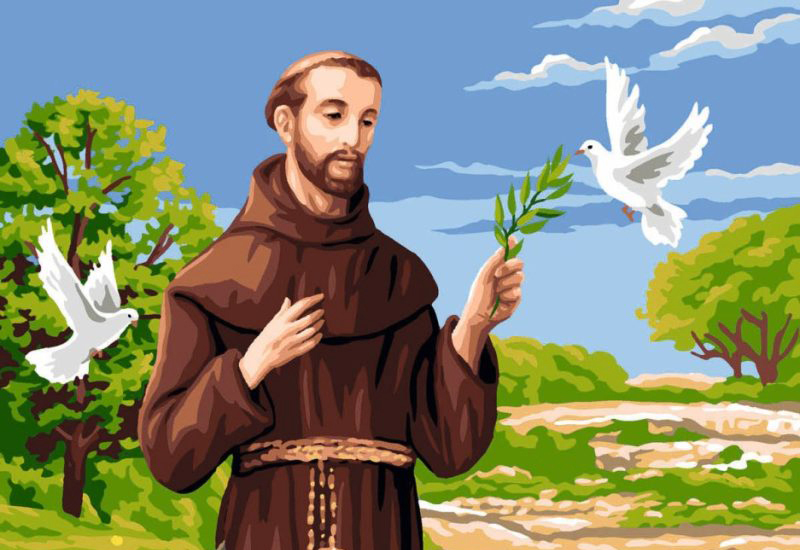
Saint Francis of Assisi died in 1226, but his approach to life did not.
There are nearly 30,000 Franciscan friars around the world in 2026, a year which marks the 800th anniversary of the death of the man born Giovanni di Pietro di Bernardone.
In honor of the 800th anniversary of Francis’ death, his remains were on display at the Basilica of Saint Francis in Assisi, Italy, from Feb. 22 to March 22.
Alta Via students and several SFU faculty and staff members will soon embark on a pilgrimage to Rome and Assisi, a trip that the University sponsors annually following the close of each academic year. Those who make this trip get to see the places that Francis called home.
“Every year, we spend five days in Assisi,” said Father Stephen Waruszewski, Director of Campus Ministry. “We visit the tomb of Saint Francis.”
Francis was born into an affluent family in 1181. As a young adult, he renounced all his physical possessions, including his clothes, during a dispute with his father. Francis did not have money, consistent shelter or even a Bible.
His love of God, demonstrated by his humility, service and respect for all creation, lives on at SFU eight centuries after his death.
“I think he’s inspiring because he’s a difficult person,” said Gregory Stacey, an Assistant Professor in the University’s Department of Theology and Philosophy. “I think it would have been very difficult to live with him.”
The friars in the SFU community are members of the Third Order Regular (TOR). While they take vows of poverty, chastity and obedience, they do not adopt Francis’ lifestyle of extreme poverty.
“The TORs seek to live out the example of Saint Francis of Assisi through an ongoing conversion to the Gospel and through emphasizing works of mercy,” said Fr. Stephen.
“He inspired a meaningful way of living. His first call from God was to rebuild the church.”
Francis interpreted God’s message literally and reconstructed the San Damiano Chapel in Assisi, Italy.
“For Francis, following Jesus meant following Him in a very literal way,” said Stacey.
Pope Leo XIV declared Jan. 10, 2026 to Jan. 10, 2027 a Franciscan Jubilee Year. All Franciscan churches around the world, including SFU’s Immaculate Conception Chapel, are pilgrimage sites to receive plenary indulgences.
Many Catholics at SFU and around the world see this Jubilee Year as an opportunity to reflect on Francis’ life and teachings.
“He shows you how beautiful the Christian life can look like,” Stacey said.